

★★★★★
I had a good experience with certified Translation Services. I didn’t expect work will be done within few weeks without any hassle. Over all I m happy , my work is done n I am going aboard very soon.
Navigating the vibrant real estate market in Chandigarh, the “City Beautiful,” often begins with a stack of traditional paperwork. While most historic land records and Bai Namas (Sale Deeds) are originally drafted in Punjabi, modern legal requirements—whether for a home loan, a High Court filing, or an NRI visa application—demand absolute clarity in English.
Securing a professional sale deed Punjabi to English translation in Chandigarh is the vital bridge that ensures your property rights are understood by banks and embassies alike. From Sector 17 to the High Court, linguistic accuracy is non-negotiable. This guide explores how expert translation secures your legacy and simplifies your legal journey in 2026.
| Category | Details |
|---|---|
| Primary Use Cases | NRI property sales, Punjab & Haryana High Court filings, bank home loans, and visa or immigration (PR / Study) applications. |
| Certified vs. Notarized | Certified translations with a signed Certificate of Accuracy are standard. Notarization is an additional step required only for specific embassies or court mandates. |
| The Process | Document review, expert Punjabi legal translation, quality verification, certification, and optional notarization. |
| Average Cost | Pricing starts from ₹500 – ₹700 per page for standard Punjabi to English property document translations. Charges vary based on text length, complexity, legal terminology, and document type. |
| Turnaround Time | 24 – 48 hours for digital copies; 1 – 3 working days for physical courier delivery within Chandigarh, Mohali, and Panchkula. |
| Validity | Legally valid for a lifetime, provided the original Sale Deed remains unchanged. |
| Real-Time Case Study | A 2025 case study involving a handwritten 1990s Bai Nama translated for a successful Canada PR application. |
| About the Company | A premier translation agency like CTS, specializing in legal Punjabi dialects and Chandigarh revenue records. |
| Client Reviews | Verified 5-star Trustpilot reviews from clients across India and overseas. |
A Sale Deed, often referred to in local parlance as a Bai Nama, is the primary legal document that evidences the transfer of property ownership from a seller to a buyer. In Chandigarh, these documents are registered at the Sub-Registrar’s Office.
While the registration happens locally, the implications are often global. When an individual seeks to present this document to a foreign embassy, a multinational bank, or the High Court, the Punjabi text must be converted into a precise, legally-sound English version.
A standard sale deed contains critical information that requires absolute accuracy during translation:
One might wonder why a document already registered with the Chandigarh Administration needs translation. The reasons are multifaceted and usually involve higher-level legal or administrative scrutiny.
A significant portion of Chandigarh’s property owners resides abroad in countries like Canada, the UK, and the USA. For these Non-Resident Indians (NRIs), managing property from afar requires submitting documents to foreign tax authorities or legal counsel. An English translation ensures that the terms of ownership are understood without ambiguity.
Leading financial institutions and banks in Chandigarh, such as SBI, HDFC or ICICI, require property documents to be in English for legal vetting before sanctioning a home loan. If the original deed is in Punjabi, the bank’s legal department will insist on a certified Punjabi to English translation.
In cases of property disputes reaching the Punjab and Haryana High Court, documents must often be submitted in English. A professional translation ensures that the legal terminology—terms like Inteqal (Mutation) or Fard (Record of Rights)—is translated into their exact legal equivalents to avoid misinterpretation by the court.
Expert Note: A literal translation is often dangerous in legal contexts. For instance, the Punjabi term “Hissadar” must be accurately translated as “Shareholder” or “Co-owner” depending on the specific context of the land record to maintain legal integrity.
While it might be tempting to use automated tools or a general translator, a sale deed Punjabi to English translation in Chandigarh requires a specialized touch. Here’s why a professional agency like Certified Translation Services-CTS is the preferred online choice for serious property matters:
Legal Punjabi is distinct from conversational Punjabi. It uses specific terminology rooted in Persian and Urdu traditions (such as Zaildar, Patwari, or Khasra). A professional agency such as Certified Translation Services-CTS uses certified translators who are not just bilingual but are experts in Indian property law.
“Mirror formatting” is a crucial part of professional service. This means the translated English document looks exactly like the original Punjabi deed—with the same layout, stamp placements, and signature blocks. This makes it incredibly easy for officials to compare the two documents side-by-side.
Most official bodies do not accept a simple printout. They require a Certified Translation, which includes:
When getting documents translated for official use, many people are unsure whether they need a certified translation or a notarized translation. While both serve important purposes, they are used in different situations depending on the authority or institution requesting the document. Understanding the difference helps you avoid delays, rejections, or unnecessary costs.
Navigating the translation process is simple when you work with an experienced, pan-India service provider like Certified Translation Services-CTS. While our head office is based in Delhi NCR, our fully digital workflow enables clients across Chandigarh and all parts of India to access our services without visiting a physical office.
Documents can be securely submitted online, reviewed by expert translators, and delivered digitally or via courier, ensuring consistent accuracy, proper certification, and full compliance with official requirements nationwide.
| Step | What Happens |
|---|---|
| 1Submission | Provide a clear scanned copy or photocopy of the original Sale Deed via email or WhatsApp (+91-9990074116) for initial review. |
| 2Evaluation | The translation agency evaluates the document based on word count, readability, and complexity (typed or handwritten). |
| 3Drafting | A professional legal translator prepares the English translation, ensuring technical, legal, and contextual accuracy. |
| 4Quality Check | A second linguist reviews the translation to verify names, dates, figures, Khasra numbers, and legal terminology. |
| 5Client Review | A draft version is shared with the client for review. After approval, the agency proceeds with certification and notarization on official letterhead, along with the translator’s affidavit. |
| 6Certification | The final translation is stamped and issued with a signed Certificate of Accuracy for legal and immigration use. |
| 7Delivery | Certified hard copies are delivered via courier, along with a digital PDF for immediate submission to courts, banks, or embassies. |
Understanding the terminology used in Punjabi sale deeds is essential when dealing with property transactions, legal verification, or official submissions in English. Punjabi property documents often contain traditional legal and revenue terms that may not have direct everyday English meanings. Knowing these terms helps property owners, buyers, and legal professionals clearly understand ownership rights, boundaries, and financial obligations, while also reducing the risk of misinterpretation during translation or legal review.
When a Punjabi sale deed is translated into English for banks, courts, embassies, or government authorities, accuracy in these key terms becomes critical. Even a minor error can affect property valuation, loan approval, or ownership verification.
By understanding these key Punjabi terms and their correct English equivalents, property owners can ensure their documents are translated accurately and accepted without queries by legal, financial, and government authorities.
“How much does sale deed Punjabi to English translation in Chandigarh cost?” is a top query for property pros. Rates vary, but expect ₹500–₹700 per page (A4, single-sided) from certified agencies—far better than freelancers’ risks.
Factors influencing price:
Turnaround: 1–2 working days
Best suited for local registry offices, internal reference, and non-certified document submissions.
Turnaround: 2–3 working days
Best suited for banks, NRIs, visa & immigration purposes, courts, embassies, and official legal submissions.
Translating a Punjabi sale deed into English requires more than basic language knowledge. Sale deeds are legally binding documents, and even a small translation error can lead to property disputes, loan rejections, or delays in registration. Being aware of common mistakes helps property owners, buyers, and legal professionals ensure that the translated document is accurate, reliable, and officially acceptable.
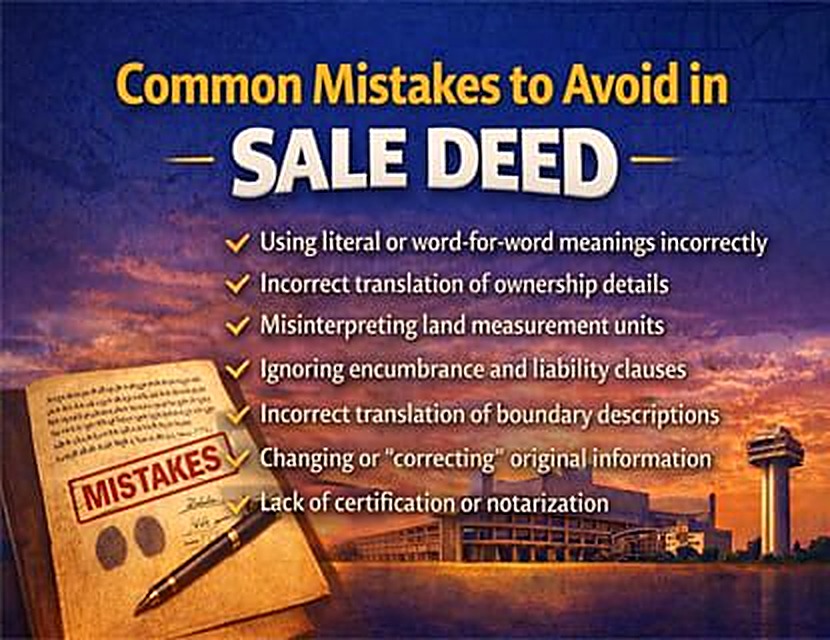
Below are some important mistakes to avoid during Punjabi to English sale deed translation:
Avoiding these mistakes by using a professional, certified document translation service ensures legal accuracy, smooth approval, and peace of mind during property transactions.
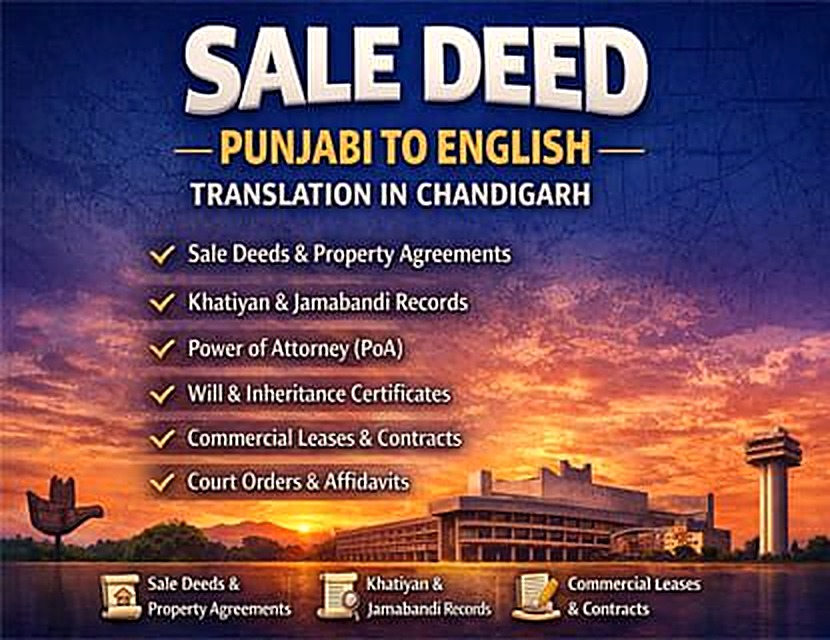
In Chandigarh’s Tricity and Punjab’s booming real estate/legal scene, Punjabi to English translation transforms local documents into universally accepted formats. Banks, sub-registrars, NRIs, and courts demand English versions for compliance—whether you’re registering property in Mohali or filing USCIS visas from the US. Here’s what tops the list:
Certified Translation Services (CTS) is a premier, digital-first linguistic powerhouse specializing in high-stakes legal, property, and immigration translations. With a deep-seated focus on accuracy and legal integrity, CTS has become a trusted name for sale deed Punjabi to English translation in Chandigarh and across the Indian subcontinent.
Our mission is to eliminate geographical barriers. While we operate a sophisticated pan-India service model without a physical storefront in Chandigarh, our expertise in the region’s specific land revenue terminology is unmatched. We employ a specialized panel of legal linguists who are veterans in deciphering the “Revenue Punjabi” used in Punjab and Haryana.
By leveraging a secure, online-to-offline workflow, we provide the precision of a local expert with the efficiency and scale of a national agency. At CTS, we don’t just translate words; we certify your property rights for a global audience.
In a city as legally meticulous as Chandigarh, your property documents require more than just a bilingual clerk. Even without a local office, CTS is the preferred choice for thousands of residents and NRIs. Here is why we lead the industry:
Our reputation for excellence is reflected in the feedback from our diverse clientele—from local homeowners in the Tri-city to NRIs residing in Canada and the UK. At Certified Translation Services (CTS), we believe that transparency is the cornerstone of trust. While we take pride in our precision, we know that real-world evidence speaks louder than words.
To ensure you feel completely confident in our ability to handle your sale deed Punjabi to English translation in Chandigarh, we invite you to browse our verified Trustpilot reviews. These independent testimonials showcase our commitment to meeting strict 2025 legal standards and the consistent high acceptance rate of our documents by the Punjab and Haryana High Court and global immigration authorities.
This case study shows how expert Punjabi to English sale deed translation helps avoid visa delays by accurately handling unclear Khasra numbers, complex legal terms, and precise formatting.
Many of the Khasra numbers were nearly illegible, and the legal terminology was archaic.
Our senior legal linguist cross-referenced the Sale Deed with the latest Jamabandi (online records) to verify the property numbers, providing a “Mirror Image” translation matching the original layout exactly, including thumbprint and signature positions.
The translation was certified and delivered within 48 hours, and the client’s visa application was processed in compliance with all embassy requirements.
Mr. Harpreet Singh, an IT professional from Mohali, received an Invitation to Apply (ITA) for Canada PR in late 2024.
To prove his “Settlement Funds,” Harpreet needed to show the value of a 12-page commercial plot Sale Deed from 2005, written in highly technical Punjabi. Under 2025 IRCC guidelines, this required a Certified Translation with a Translator’s Affidavit and a certified true copy.
We provided a “Mirror Image” translation with a dedicated Certificate of Accuracy on official letterhead, and arranged a formal affidavit before a Notary Public.
Harpreet submitted his documents via the IRCC portal and was very satisfied — the documents met all requirements set by the legal authorities.
Ms. Ananya, a student from Chandigarh applying for a Master’s at the University of Melbourne.
Under the 2025 Genuine Temporary Entrant (GTE) assessment, Ananya had to prove strong economic ties to India using her family’s ancestral farmhouse deed — a decades-old, handwritten Bai Nama with faded ink.
Our senior linguists deciphered the archaic script and used historical land records to verify the Khasra numbers, ensuring her father’s name as primary owner matched her financial sponsorship documents exactly.
The translation was completed within the timeframe and met all requirements set by the embassies.
An NRI family based in the UK involved in a boundary dispute in Sector 35, Chandigarh.
The Punjab and Haryana High Court required all vernacular evidence translated into English, and the opposing party contested the translation of a clause on “easement rights.”
A Legal Specialist Translation correctly rendered terms like Haq-e-Asayish (Easement Rights) and Shajra (Map), plus a “Court-Ready” format with line numbering for the advocates to reference during the hearing.
The court accepted our translation as a “True and Correct” version, and the technical accuracy prevented the opposing counsel from dismissing the evidence on linguistic grounds.
A family from Zirakpur seeking an education loan from a private bank for their daughter’s PhD in the USA.
The bank’s legal cell required a “Chain of Title” going back 30 years. The current Sale Deed was in English, but the previous Mutation (Inteqal) and mother deed from the 1990s were in Punjabi.
We translated the entire chain — from the old Punjabi Sale Deed to the latest Jamabandi records — with consistent names and property descriptions across four historical documents.
The bank’s legal department approved the collateral within 10 days, and the loan was disbursed in time for the fall semester.
Distance is no longer a barrier to quality. Whether you are sitting in Chandigarh or halfway across the world, Certified Translation Services (CTS) brings world-class linguistic expertise to your screen.
Navigating the complexities of property documentation in Chandigarh requires more than just a literal translation; it demands a deep understanding of local revenue laws and linguistic nuances. Whether you are managing ancestral land from abroad or securing a local home loan, a precise sale deed Punjabi to English translation in Chandigarh is your safeguard against legal delays.
At Certified Translation Services (CTS), we take pride in bridging this gap with accuracy and integrity. By choosing a trusted partner, you ensure that your Bai Nama is legally sound and globally recognized. Let us help you secure your property interests with confidence and ease.